About Anjan
Anjan Shah is a saxophonist, bansuri artist, composer, educator, and cultural bridge builder whose work explores the intersection of Hindustani tradition, jazz improvisation, and Western classical music. Through performances, original compositions, and cross-cultural collaborations, he creates artistic experiences that build community, foster belonging, and reveal the universal human stories that connect people across cultures.
A graduate of Michigan State University, Shah began graduate studies at the University of Illinois before winning a position with the United States Army Field Band. During his five year tenure with the band, he performed more than 670 concerts throughout the United States, Canada, and Europe, appeared as a featured soloist more than 150 times, and presented master classes for students and audiences around the world.
Following his military service, Shah collaborated with artists including Phil Woods, Johnny Mathis, Natalie Cole, Linda Ronstadt, Michael Feinstein, Marvin Hamlisch, and Seth MacFarlane, toured with the Royal Philharmonic Orchestra and the Baltimore Symphony, and performed with major American orchestras and presenters. As a founding member of the Capitol Quartet, he appeared under conductors including Yuri Temirkanov, Marin Alsop, Jack Everly, Jeff Tyzik, John Russell Morris, and Marvin Hamlisch. The ensemble's recordings—American Sketches, Anything Goes, and DIG—were praised for their lush sonority, stylistic versatility, and uninhibited musical energy.
While Shah's professional life was firmly rooted in jazz and Western classical traditions, his artistic journey was shaped by a different tension. As a first-generation Indian American, he spent much of his life doing what many children of immigrants do: working to assimilate into the culture around him. His education, military career, and professional musical life were built almost entirely within Western traditions, while the cultural influences of his Indian heritage remained largely in the background.
Throughout his life, however, his father, Girish Shah, encouraged him to explore ways that his Indian heritage and Western upbringing might one day coexist within a single artistic voice. While Shah appreciated the idea, it would take decades for him to fully understand what his father saw.
That changed following his father's passing in 2020.
In September 2021, during a temple service honoring his father's life, Shah experienced what he describes as an "aha" moment. Surrounded by the music, prayers, and rituals that had been part of his family's traditions for generations, he suddenly recognized that the two worlds he had always viewed separately did not need to remain separate. For the first time, he could envision a musical language capable of bringing together the influences that had shaped him as both an artist and a person.
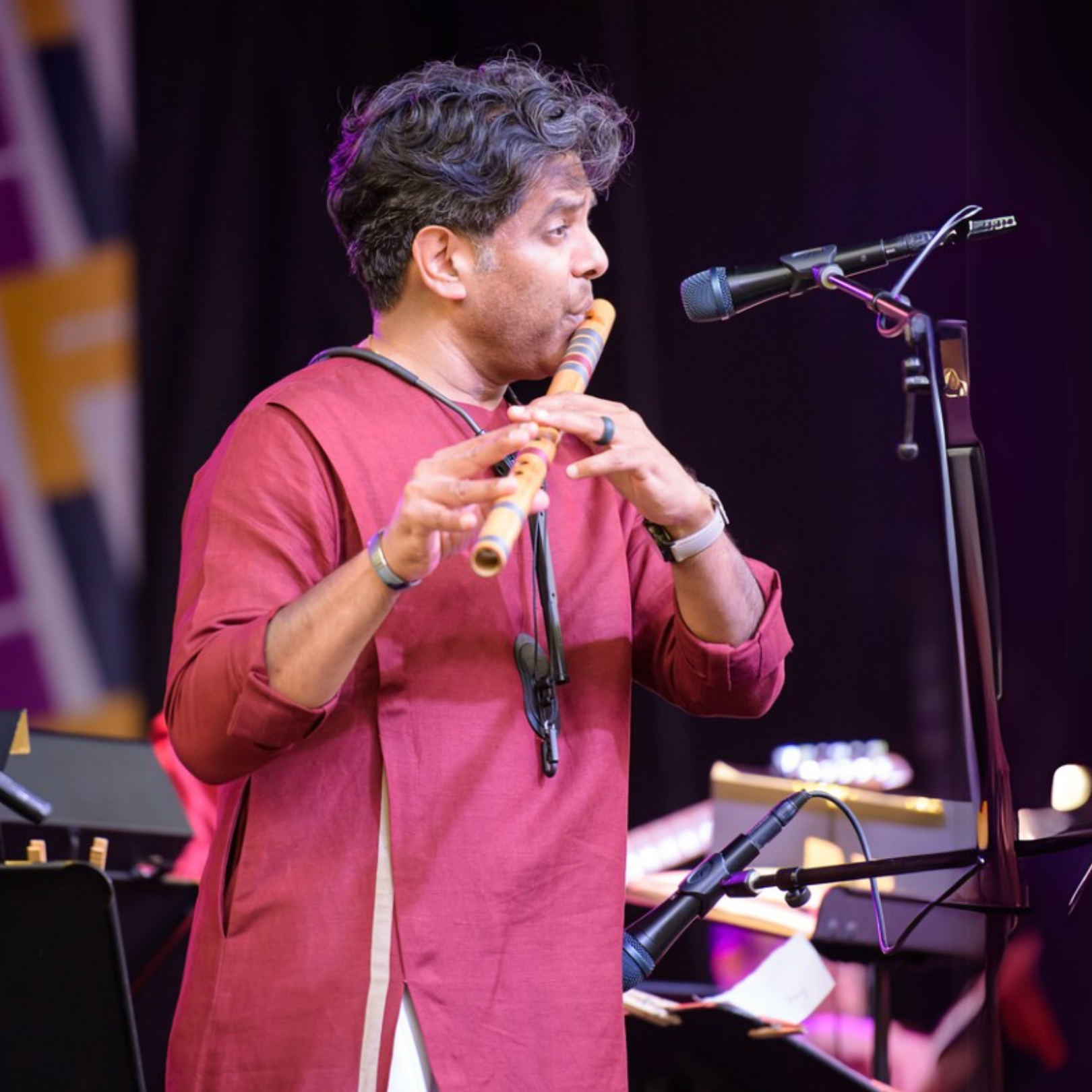
Soon afterward, he began studying bansuri, the North Indian bamboo flute. More than learning a new instrument, the experience became a means of reconnecting with a part of himself that had long remained unexplored. The instrument opened a doorway into a deeper understanding of Indian musical traditions while providing a new creative lens through which to view his work as a saxophonist, improviser, and composer.
That realization led Shah to approach composer Drew Zaremba with an ambitious idea: create a work that could authentically bring together Hindustani music, jazz improvisation, and orchestral writing without compromising the integrity of any tradition. The result was Nightfall Rhapsody (Rhapsody in Raag Jog), a twenty-two-minute work for tenor saxophone, bansuri, tabla, guitar, bass, and strings.
Dedicated to the memory of his father, Nightfall Rhapsody became the artistic catalyst for everything that followed. The project demonstrated that meaningful dialogue between traditions could be achieved without reducing them to novelty or fusion. More importantly, it revealed a creative path that felt deeply personal and artistically authentic.
From that experience emerged the Temporal Taal Collective, an ensemble devoted to creating original repertoire that brings together Hindustani music, jazz improvisation, chamber music textures, and orchestral storytelling. Featuring Shah on tenor saxophone and bansuri alongside tabla virtuoso Nabin Shrestha, bassist Amy Shook, guitarist Jonathan Epley, Kathak dancer Sarah Morelli, and guest artists, the Collective explores rhythm as narrative, improvisation and movement as conversation, and music and dance as a vehicle for cultural dialogue.
The Collective serves a larger purpose as well. Shah believes that many people do not see themselves reflected in traditional concert experiences, not because the music lacks relevance, but because they have never been invited into the conversation. Through performances, educational residencies, and orchestral collaborations, the ensemble creates welcoming points of entry for audiences who may feel disconnected from classical music while simultaneously demonstrating that the emotions at the heart of great art transcend culture, language, and geography.
Recent presentations of Nightfall Rhapsody with the Charlotte Symphony, Hopkins Symphony Orchestra, and Bay Atlantic Symphony have demonstrated the broader potential of this approach. Beyond the performance itself, these collaborations fostered meaningful dialogue among audiences, donors, sponsors, administrators, and musicians, illustrating how culturally specific stories can become catalysts for deeper community connection and shared understanding.
That artistic vision continues to evolve through Shah's work as a composer. His newest project, What The River Remembers, is a twenty-minute, four-movement composition for orchestra and the Temporal Taal Collective inspired by a journey to India following his father's passing. Standing on the banks of the Narmada River during the immersion of his father's ashes, Shah was struck not by a sense of finality, but by the river's enduring continuity. The feeling that this river had carried countless stories, prayers, losses, and memories long before his family's and would continue carrying them long after.
The composition explores themes of memory, migration, ancestry, loss, renewal, identity, and belonging. While deeply personal in origin, it reflects Shah's belief that the most powerful artistic experiences emerge when specific cultural stories reveal something fundamentally human. Through the lens of one family's experience, What The River Remembers invites audiences to reflect upon their own histories, relationships, and connections to those who came before them.
In addition to his work as a composer and ensemble leader, Shah continues to appear as a featured soloist with orchestra. Current programs include A Symphonic Tribute to the Sound of the 1950s, featuring the Bennett Concerto for Stan Getz alongside Shah's original compositions Velvet Horizon and Confluence 1959, and a performance program centered on Heitor Villa-Lobos' Fantasia for Soprano Saxophone and Chamber Orchestra. Together, these programs reflect his commitment to expanding the orchestral repertoire while creating meaningful connections between audiences, traditions, and musical styles.
Whether performing as a soloist, leading the Temporal Taal Collective, or composing new works for orchestra, Shah's artistic mission remains constant: to build community through music. He believes that orchestras and performing arts organizations are uniquely positioned to create spaces where people from different backgrounds can gather around shared experiences and discover common ground. His work seeks to create pathways into the concert hall for audiences who may not traditionally see themselves reflected there, while reminding all listeners that the emotions at the heart of great music—love, loss, joy, longing, memory, and hope—belong to everyone.
Beyond the Stage
In addition to his artistic career, Shah holds an MBA from Loyola University Maryland and has built a parallel career as a marketing strategist and growth leader across the performing arts, education, retail, franchise, industrial, and e-commerce sectors. He has led marketing and revenue initiatives for organizations including the Baltimore Symphony Orchestra, Newberry Opera House, Music & Arts, Bertrand's Music, Yamaha, IKEA North America, Celebree School, JazzWire, and numerous cultural institutions and consumer brands.
His work spans audience development, brand strategy, donor engagement, lifecycle marketing, and revenue growth. Whether building a marketing strategy for a performing arts organization or composing a new orchestral work, Shah approaches both disciplines through the same lens: aligning vision, structure, and human connection to create meaningful impact.
Based in Baltimore, Maryland, Anjan Shah continues to perform internationally as a soloist, composer, educator, and collaborator while developing new works that expand the possibilities of cultural dialogue through music and create pathways for audiences to see themselves—and one another—more clearly.